This post contains affiliate links. If you buy through them, this site may earn a small commission at no extra cost to you. Learn more.
Walk into a kitchen shop in Japan and the knife wall can be overwhelming. Dozens of shapes, each with its own name. The good news is that almost every home cook needs only one of three: the gyuto, the santoku or the nakiri.
This guide explains what each one is for, who it suits, and how to choose your first. If you only read one line, read this: most people should start with a santoku or a 210 mm gyuto.
The three knives at a glance
| Gyuto | Santoku | Nakiri | |
|---|---|---|---|
| What it is | Japanese chef’s knife | All-purpose home knife | Vegetable knife |
| Typical length | 210 to 240 mm | 165 to 180 mm | 160 to 180 mm |
| Tip | Pointed | Rounded, dropped | Square |
| Best at | Everything, including meat and fish | Vegetables, meat and fish in a small kitchen | Chopping vegetables straight down |
| Best for | Cooks used to a Western chef’s knife | Most home cooks | Vegetable-heavy cooking |
Gyuto: the Japanese chef’s knife
The gyuto (literally “beef sword”) was developed in Japan in the late 1800s, modeled on the French chef’s knife. It has a long blade, a gentle curve and a pointed tip, so it handles rocking cuts, slicing meat and fine tip work.
Compared with a German chef’s knife, a Japanese gyuto is usually thinner, lighter and made from harder steel. That means a sharper edge that lasts longer, with one trade-off: hard, thin edges can chip if you twist them through bones or frozen food.
- Choose a gyuto if you already cook with a chef’s knife, cut a lot of meat, or have plenty of counter space.
- Size: 210 mm suits most home kitchens. Pick 240 mm only if you are confident and have a large board.
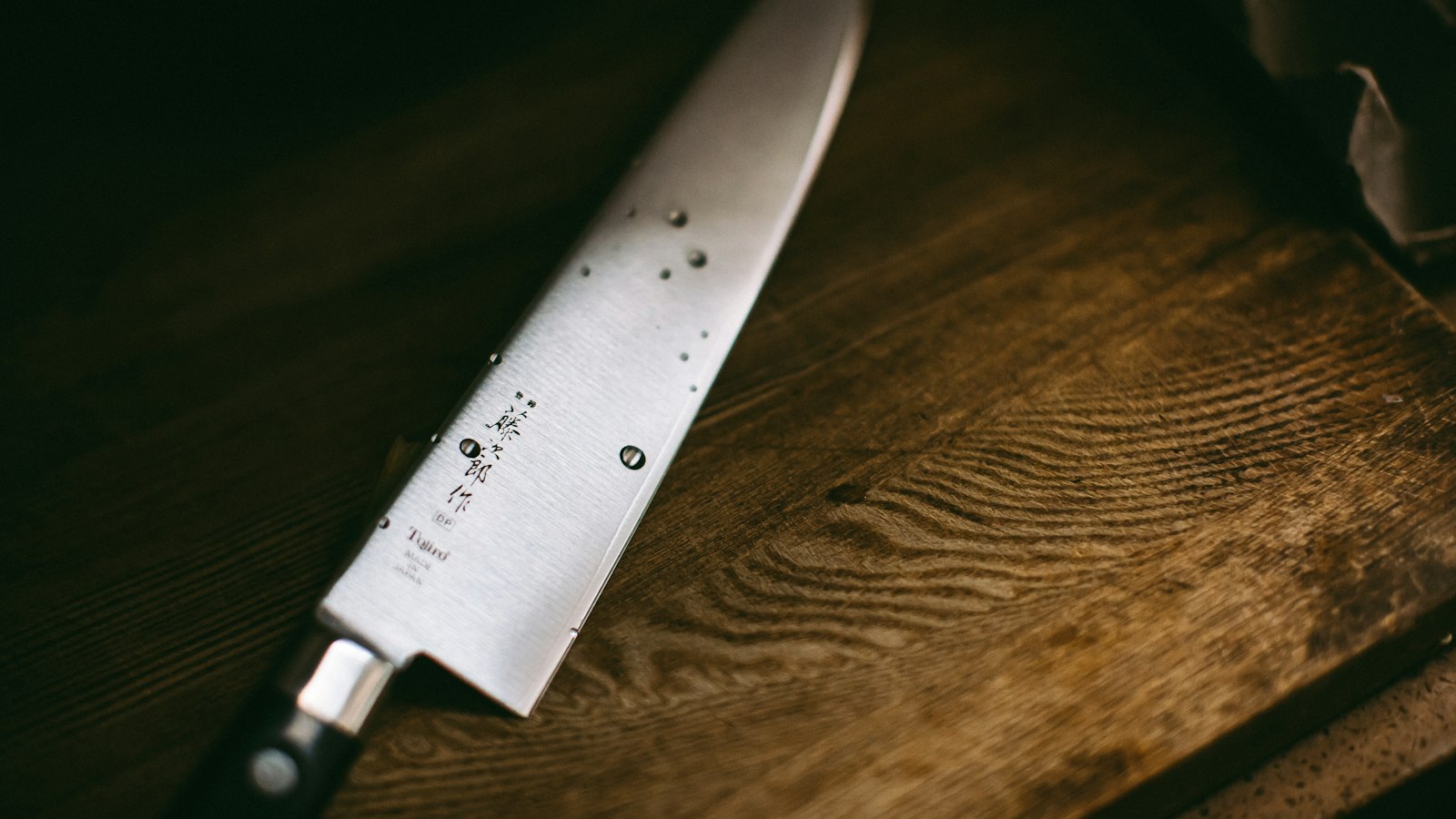
A good first gyuto: Tojiro DP 210 mm
Made in Niigata, with a hard steel core and a familiar Western-style handle. It is the knife many professional cooks recommend as a first step into Japanese knives.
Santoku: the knife in most Japanese homes
Santoku means “three virtues”, usually explained as meat, fish and vegetables, or slicing, dicing and mincing. It became the standard home knife in Japan in the twentieth century and is still the knife you are most likely to find in a Japanese family kitchen.
A santoku is shorter than a gyuto, with a flatter edge and a rounded, dropped tip. The flatter edge favors a push-cut or up-and-down chopping motion rather than rocking, and the shorter length is easy to control.
- Choose a santoku if you have a small kitchen or board, mostly cook vegetables and everyday meals, or prefer a knife that feels nimble.
- Size: 165 to 180 mm is standard.
Good santoku options
Tojiro and Kai both make well-priced santoku knives in Japan. Kai’s Seki Magoroku line is sold in ordinary Japanese shops and is a practical everyday choice. As always, check the listing for the country of manufacture.
Nakiri: the vegetable specialist
The nakiri has a tall, rectangular blade and a completely flat edge. It is designed for one thing: chopping vegetables with a straight up-and-down motion, with the whole edge meeting the board at once. Nothing gets left joined at the bottom, which makes it very satisfying for shredding cabbage or slicing onions.
Its square tip makes it less useful for meat or detailed tip work, so it works best as a second knife, or as a first knife for people who cook mostly vegetables.
- Choose a nakiri if you cook mostly plant-based meals, or want a second knife alongside a gyuto.
- Size: 160 to 180 mm.
So which should you buy first?
- You cook a bit of everything and want one knife: santoku.
- You are used to a Western chef’s knife: 210 mm gyuto.
- You cook mostly vegetables: nakiri, or a santoku if you also cook meat.
- You are buying a gift and are not sure: santoku. It suits the widest range of cooks and kitchens.
Whichever you choose, pick stainless steel for a first Japanese knife. Carbon steel takes a wonderful edge but rusts if it is not dried straight away.
How to tell a real Japanese knife
Many knives sold online use Japanese names and wave patterns but are made elsewhere. If it matters to you, look for a stated country of manufacture, a maker based in a knife-making region such as Seki, Sakai, Tsubame-Sanjo or Echizen, and a named steel such as VG-10. The Japanese knife gift guide covers this in more detail.
Looking after your knife
- Wash by hand and dry straight away. Never put it in the dishwasher.
- Use a wooden or soft plastic board, not glass or stone.
- Avoid twisting the blade through bones or frozen food.
- Sharpen on a whetstone rather than a pull-through sharpener. A 1000/6000 combination stone is the classic place to start.