This post contains affiliate links. If you buy through them, this site may earn a small commission at no extra cost to you. Learn more.
Search for “Japanese knife” online and you will find hundreds of listings with Japanese-sounding names, kanji on the blade and dramatic wave patterns. Many of them are not made in Japan at all. They are Japanese-style: designed to look like Japanese knives, but produced elsewhere.
That is not automatically a problem. Some Japanese-style knives are perfectly decent. But if you want a knife actually made in Japan, or you are paying a made-in-Japan price, it is worth knowing how to tell the difference. Here is what to check.
1. Look for the country of manufacture, not the brand story
The single most reliable check is the stated country of manufacture. On Amazon, scroll to the product details and look for Country of Origin. On specialist shops, it is usually in the specifications.
Be wary of phrases that sound like an answer but are not one:
- “Japanese design” or “Japanese-inspired”
- “Made with Japanese steel” (the steel may be Japanese while the knife is made elsewhere)
- “Traditional Japanese craftsmanship” with no maker or place named
Also note that some well-known Japanese brands make certain lines outside Japan. A Japanese brand name alone does not settle it. Check the listing for each specific knife.
2. Check for a real maker and a real place
Genuine Japanese knives come from makers with a history, almost always based in one of the country’s knife-making regions. If a listing names one of these places and a maker you can look up, that is a good sign.
| Region | Prefecture | Known for |
|---|---|---|
| Seki | Gifu | Japan’s largest cutlery center, home to Kai, MAC and Misono |
| Sakai | Osaka | Traditional single-bevel knives used by many professional chefs |
| Tsubame-Sanjo | Niigata | Metalworking towns, home to Tojiro and Global |
| Echizen | Fukui | Hand-forged knives with centuries of history |
| Tosa | Kochi | Rustic, hand-forged blades |
| Miki | Hyogo | Blacksmithing and carpentry tools as well as knives |
3. Read the steel name carefully
Japanese knives usually name their steel precisely. Common examples include VG-10, SG2 (also called R2), Aogami (blue paper steel) and Shirogami (white paper steel). A precise steel name is a good sign of a serious knife.
However, the steel name is not proof of where the knife was made. Japanese steels such as VG-10 and AUS-10 are sold to knife factories around the world. Treat the steel name as one clue, alongside the country of manufacture and the maker.
4. Watch for these red flags
- A Japanese-sounding brand with no company information. Search the brand name. A real Japanese maker will have a history, an address and other products.
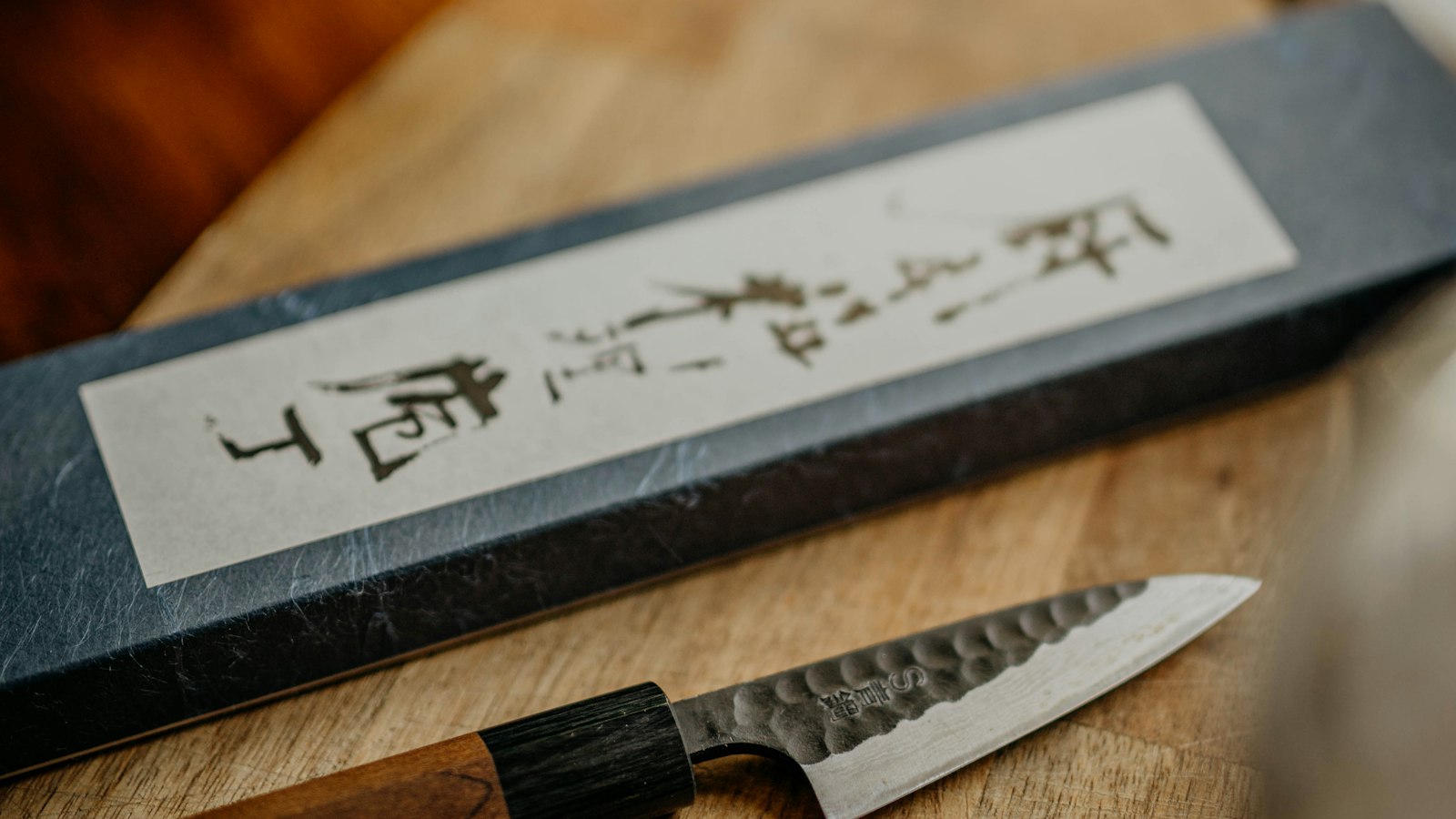
- Kanji that do not mean anything. Some blades carry random or decorative characters. Real makers usually stamp their name or their town.
- A “Damascus” pattern that looks printed. A genuine layered blade shows the pattern because of the layers of steel. Some cheap knives etch or laser a wave pattern onto a plain blade.
- Very low prices for big claims. A “67-layer VG-10 Damascus” knife for $25 is unlikely to be what it sounds like.
- Gift-box gimmicks. Heavy emphasis on the box, a “certificate” and dramatic photos, with little detail about the knife itself.
5. Know what a fair price looks like
A genuine, entry-level made-in-Japan chef’s knife from a recognized maker typically costs more than a mass-market Japanese-style knife. As a rough guide, many well-regarded first Japanese knives sit in the $60 to $150 range, and hand-forged knives from small workshops go much higher. If a “handmade Japanese” knife costs less than a nice dinner out, ask why.
Is a Japanese-style knife always a bad buy?
No. Some Japanese-style knives are well made and good value, and they can be a reasonable first step. The problem is only when a listing implies a knife is made in Japan when it is not, or when you pay a made-in-Japan price for something else. Knowing the difference simply lets you choose with your eyes open.
Made-in-Japan knives worth considering
Tojiro DP gyuto 210 mm
Made in Tsubame-Sanjo, Niigata. A long-standing favorite as a first Japanese knife, with a comfortable Western handle.
MAC Professional chef’s knife
Made in Seki. Thin, light and very sharp, popular in professional kitchens.
Global chef’s knives
Made in Tsubame-Sanjo by Yoshikin. A one-piece stainless design that is easy to care for.
Sakai Takayuki
A well-known name from Sakai, with a wide range from everyday stainless knives to traditional single-bevel blades.
Not sure which shape to buy? Start with gyuto vs santoku vs nakiri. Buying for someone else? See how to pick a Japanese knife as a gift.